


Optics First for Outdoor Architectural Lighting — Why Bright Fixtures Still Fail Facades
Brightness is not the same as correct light. Distribution, aiming, cutoff, and commissioning decide whether façades work at night.
At night on many façades the same scene shows up: a bright linear strip at the base, dark upper floors, glare at eye level on the plaza, spill into bedroom windows or the sky. The fixtures are on. The architecture is not lit.
That is rarely a lumen shortage. It is usually an optics problem—distribution, aiming, cutoff, and commissioning left until after wattage, IP rating, and “bright enough.” For outdoor architectural work, especially linear wall wash and façade flood aiming, brightness is not the same as correct light. Optics-first selection and delivery decide whether light lands where the design intended.
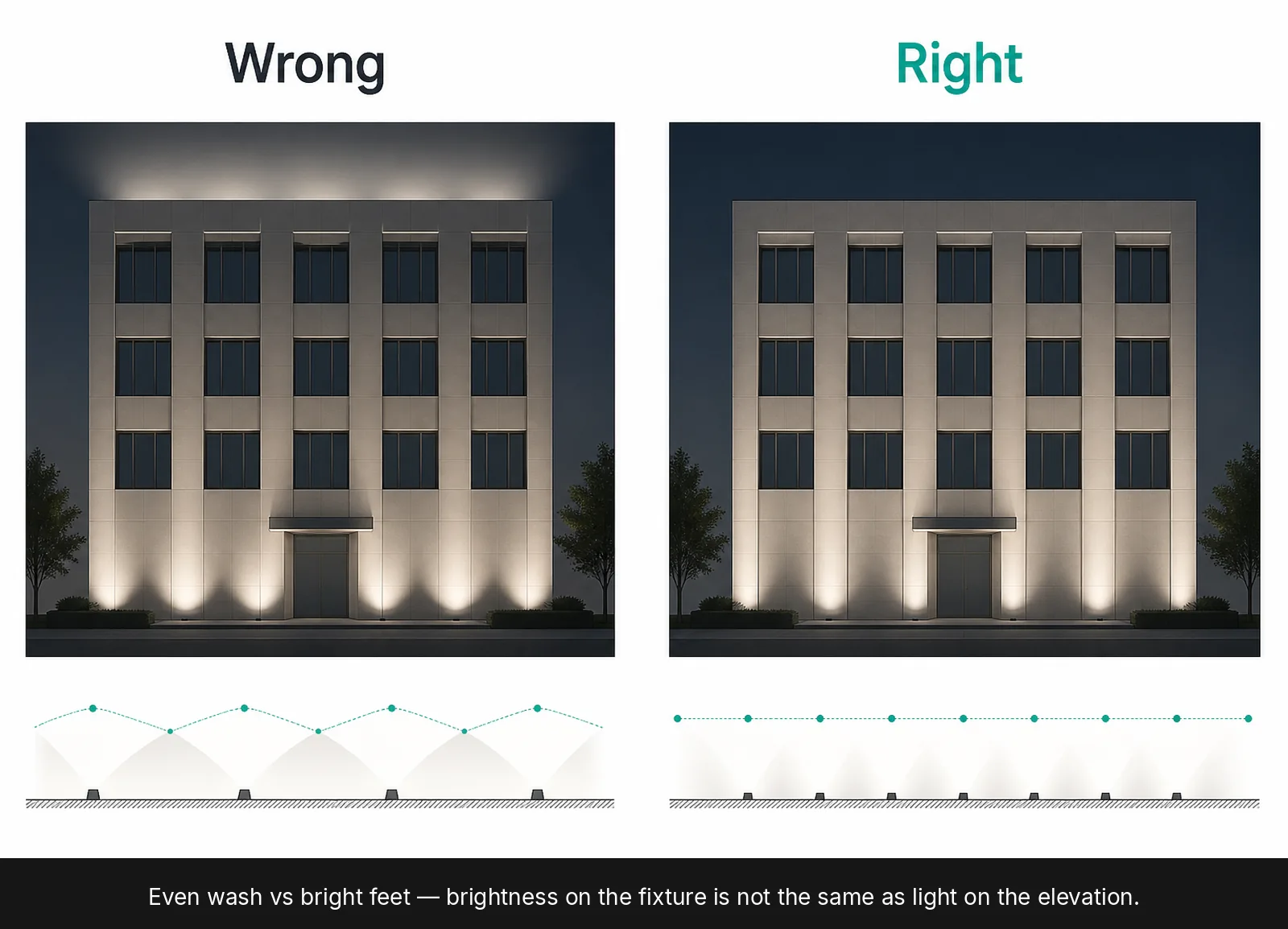
Why Façades Still Fail: Four Gaps in the Chain
Product: parameters without distribution
Catalogs lead with lumens, CCT, CRI, and IP. Those matter, but they do not describe how light leaves the fixture. Without an IES or LDT file, a photometric curve, and a clear beam or asymmetric distribution claim, a specifier cannot verify wall-wash falloff, cutoff, or glare risk in DIALux or AGi32. Buying “high output” without distribution is buying an unknown pattern on the building.
Design: points on the drawing, no aim or beam notes
Plans often mark fixture locations and a generic type. They less often lock setback from the wall, mounting height, tilt, beam option, or intended aim points on the elevation. Without those notes, installers energize defaults—and the night scene becomes whatever the default optic and angle produce.
Install: energize is not optical commissioning
Power-on confirms wiring and drivers. It does not confirm that the wash is even, that upper floors receive light, or that spill and glare are controlled. Optical commissioning—aim, lock, walk, adjust—is a deliverable, not an optional punch-list item.
Owner / acceptance: “bright enough?” instead of the right questions
Handover still centers on whether the building “looks bright.” Better acceptance language asks about uniformity on the elevation, glare at pedestrian and balcony sightlines, and spill to neighbors and sky—checked against the project criteria, not a single universal number.
Selection: Put Light Distribution First
Before comparing lumen packages, lock the optical decision. The table below is a practical order of questions for façade and outdoor linear work. For wall wash and linear aiming, ask for IES/LDT and verify marketing claims against the curves. Guidance on how to choose an LED wall washer starts from the same habit.
| Decision dimension | What to decide | Specifier note |
|---|---|---|
| Beam angle | Narrow / medium / wide (or discrete optic options) | Match throw distance and target height; wider is not always more even. |
| Distribution shape | Symmetric flood vs asymmetric wall-wash for façades | Asymmetric wall-wash is the usual façade tool. IES Type I–V labels apply to roadway / area / pathway poles only—do not use them to specify wall washers. |
| Intensity falloff | How quickly candela drops with angle and distance | Read the curve: steep falloff can leave upper floors dark; soft falloff can spill past the cornice. |
| Cutoff / uplight | Shielding, glare control, sky spill | North America: BUG ratings per IES TM-15. EU/UK practice: CIE 150 and zonal uplight ratio (ULR) thinking. Do not treat a single “UOR ≤1%” line as a universal hard rule. |
| Glare | Outdoor glare for the scene | Use outdoor GR where the project scope calls for it. Do not import indoor UGR as façade acceptance. GR is not required for every façade package. |
| CCT / CRI / TM-30 | Appearance and color quality | Lock CCT for hierarchy and night ambience; use CRI and, where specified, TM-30 for material fidelity—after distribution is settled. |
Ask for IES or LDT files early. Run them in DIALux or AGi32. If a claim cannot be seen in the file, treat it as unverified.

Scene Principles: Façade First, Then Supporting Layers
Low, mid, and high façade aiming
Ground-mounted or low linear washers must throw to the intended band of the elevation without hot feet and dark crowns. Mid-height mounts shorten throw but raise glare risk for balconies and opposite windows. High mounts and cornice lines often need narrower beams or tighter cutoff. Setback, optic, and tilt work as one system: change one and re-check the others. Practical spacing, setback, and DIALux checks for wall washers belong with optic choice.

Landscape hierarchy (rule of thumb, not law)
Primary architectural surfaces, secondary trees or features, and tertiary accents should not all compete at the same brightness. A common project rule of thumb is a stepped hierarchy (for example, keeping secondary planting well below primary façade levels—sometimes discussed around plant levels ≤60% of primary, when the lighting designer sets it). Treat such ratios as project or rule-of-thumb guidance, not a code absolute.
Pathways and plazas: where Type II / III / V belong
For poles and area lighting along paths and plazas, IES Type II, III, or V distributions (and related Types I–V) are the right language. They describe roadway and area patterns. Keep that vocabulary off wall-washer and linear façade datasheets; using Type I–V for wall wash is a common specification error.
Water features (optional aside)
If water is in scope, reflections amplify aiming errors and spill. Keep underwater packages on their own photometric and maintenance track; do not borrow façade wash optics for submerged work without a dedicated design.
Light pollution in four short types
Outdoor schemes typically manage four spill modes: sky glow (uplight), light trespass (neighbors), glare (discomfort / disability for users), and clutter / over-illumination (competing brightness without hierarchy, or simply too much light for the scene). Optics, shields, aiming, and curfew controls address them together; lumen count alone does not.
Commissioning Is a Deliverable
Treat optical commissioning like any other MEP handover item: documented aim points, setback and tilt as installed, a glare walk at pedestrian and critical sightlines, a spill check to property lines and sky-sensitive zones, then lock angles and record as-built aiming. Energize-only handovers leave the optics gap open.
Frame acceptance against project criteria. Uniformity (U₀), illuminance levels, and outdoor GR limits should match what the lighting designer and owner agreed for that elevation or space. Numbers sometimes cited in practice—such as U₀ ≥ 0.4, GR ≤ 45, vertical illuminance ratios near 1:3, pole spacing around 1:3–1:4 of mounting height, or CCT tolerance bands near ±200 K—are common references or project specs where the lighting expert allows them, not universal outdoor laws. Do not hard-code them into every specification without design review.
Troubleshooting: symptom → likely optical cause
| Symptom on site | Likely cause | First adjustments |
|---|---|---|
| Uneven wash / bright base, dark upper | Setback too tight, optic too wide or too soft, tilt wrong | Revisit setback and optic; adjust tilt; verify IES vs installed SKU |
| Spill past cornice / into sky or neighbors | Beam too wide, insufficient cutoff, aim too high | Narrower beam, shield / hood, lower aim; re-check BUG / ULR intent |
| Glare at eye height or balconies | High intensity toward sightlines, missing honeycomb or shield | Add honeycomb / shield, raise cutoff, shift aim off gaze path |
| Hot spots / scallops | Spacing vs beam mismatch, mixed optics on one run | Re-space or unify optic; re-run calculation before re-aim |
| “Bright but flat” / no hierarchy | Same level on façade, landscape, and path | Dim layers per scene plan; do not only add more fixtures |
Specifier takeaway
Fixtures that are merely “on” waste energy, create rework, and invite glare and neighbor complaints. Distribution, aim, and commissioning that match the elevation put light where the design put it—with less spill and fewer night-time callbacks. That is the practical meaning of optics first for outdoor linear and wall-wash work.
For the next package, keep the same order: distribution before lumens, aim notes before energize, project criteria before slogans. Deeper notes on wall-washer choice and setback sit in the linked pieces above.