


Traxon Media Tube Go Alternative: Evaluating TPK Lightning LLS-OP-D50
A technical selection guide to wall-mounted appearance, cable routing, power architecture, pixel layout and project documentation — written for new projects and for replacement in an existing installation.
Start with the exact reference configuration
If your specification references Traxon Media Tube Go, TPK LLS-OP-D50 is worth evaluating for outdoor direct-view building outlines and architectural accents. It is not an automatic drop-in replacement. The useful question is whether a selected D50 configuration meets the visual, mechanical, electrical and control requirements of the project.
The referenced 2025 Media Tube Go RGBW diffused 1200 mm model is TU.AL.B1124G0, item DL25102874055. Its published specification lists 12 pixels at 100 mm pitch, 48V DC input, 16.8 W consumption and DMX512 control. The family also includes 300 mm and clear-view versions, and clear and diffused optics must not be treated as interchangeable.
Earlier Media Tube Go products have different configurations. When an existing installation is being assessed, read its own documents rather than this page; this guide is locked to the September 2025 RGBW specification.
Reference models Two order codes, or no comparison
Specification V1.1, September 2025, is the reference for this guide. Page 1 of that PDF carries a stale “10 pixels per metre” sentence; the detailed specification and the order codes give 100 mm pitch and 12 pixels for the 1200 mm version. This page follows the detailed specification rather than merging generations.
The D50-L12 is 1222 mm long and rated at 28 W maximum. Its RGBW pixel configuration uses 10 independently controlled pixels, occupying 40 channels. D50 is available as separate 24V DC and 100–277V AC order versions; there is no 48V D50 version in the current product information.
Consequently, the referenced 48V supply cannot be retained as a direct power source for D50, and a 12-pixel scene cannot be transferred unchanged to a 10-pixel fixture. The appropriate approach is to review the power layout and remap the content, not to assume matching interfaces because both products use DMX.
What the differences actually mean
The table is split into four panels by the kind of decision each item affects. Values are read from the referenced Traxon specification and from current D50 product information; this is a configuration comparison, not a family-wide equivalence claim.
Dimensions and appearance The part you can see from the street
Compare the mounted envelope, not the body height alone. Media Tube Go is quoted with its bracket included; the D50 figure is the body and needs the bracket allowance added.
Electrical and control The part that changes the design
Consult the selected order codes before procurement. A family name does not fix voltage, pixel count or colour option.
Optics and environment Where the numbers are not directly comparable
Documentation Match the project requirement, not the logo count
Certification coverage follows the manufacturer’s confirmation of standard-range coverage. Custom versions are reviewed separately; attach both voltage-specific certificates and the model schedule.
Wall-mounted appearance: daytime profile and nighttime effect
A facade fixture is visible during the day as well as at night. Compare the housing width, the complete stand-off from the wall, bracket visibility, cable exits and the space needed behind the fixture. In a narrow recess, a wider body may determine feasibility before optical performance is considered at all.
D50 offers direct surface mounting, a surface bracket and a custom spring-clip option according to its current product information. These options give the project team alternative ways to develop the installation detail; they do not mean an existing Traxon bracket can be reused. Check the actual fixing drawing for the ordered mounting method.
A 50 mm body with the mounting allowance added is a different proposition from a 24 mm body quoted together with its bracket. That difference is settled in the detail drawing, not in the datasheet headline. Ask for the fixing drawing of the ordered mounting method, and check the stand-off, the bracket footprint and the cable exit positions against the recess that actually exists.
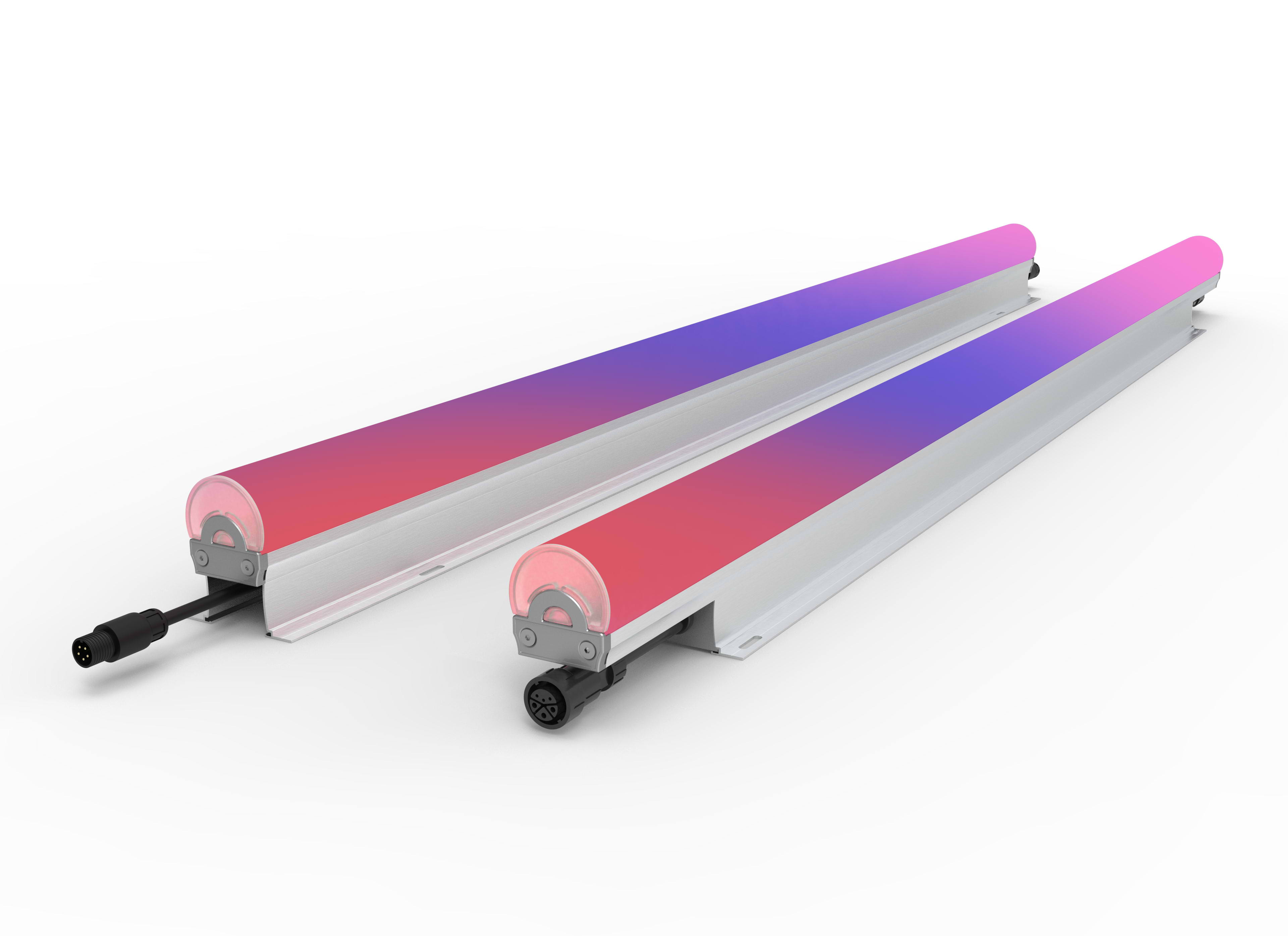
A soft line, and ten addressable sections inside it
The D50 uses an inner diffusing PC layer and an anti-UV outer layer. The intended result is a soft visible line rather than exposed LED points. A diffuser that hides individual LEDs does not remove the independently controlled pixel sections.
A useful demonstration includes steady white, a single colour, adjacent contrasting pixels and a slow moving scene. Each view answers a different question: steady light shows diffuser and joint appearance, contrasting pixels show colour boundaries and spill between sections.
A luminous line is not a wall-washer
A direct-view fixture may spill light onto the adjacent surface. Wall colour, surface texture and stand-off affect the visible result. Judge the intended luminous line and any surrounding spill separately: a bright patch on a nearby wall is not evidence of long-throw wall-washing capability.
If only D50 samples are available, present the photographs as D50 installation examples. Pair them with labelled competitor drawings if that helps the review, but do not describe them as a measured head-to-head optical test.
Cable routing, connector clearance and maintenance access
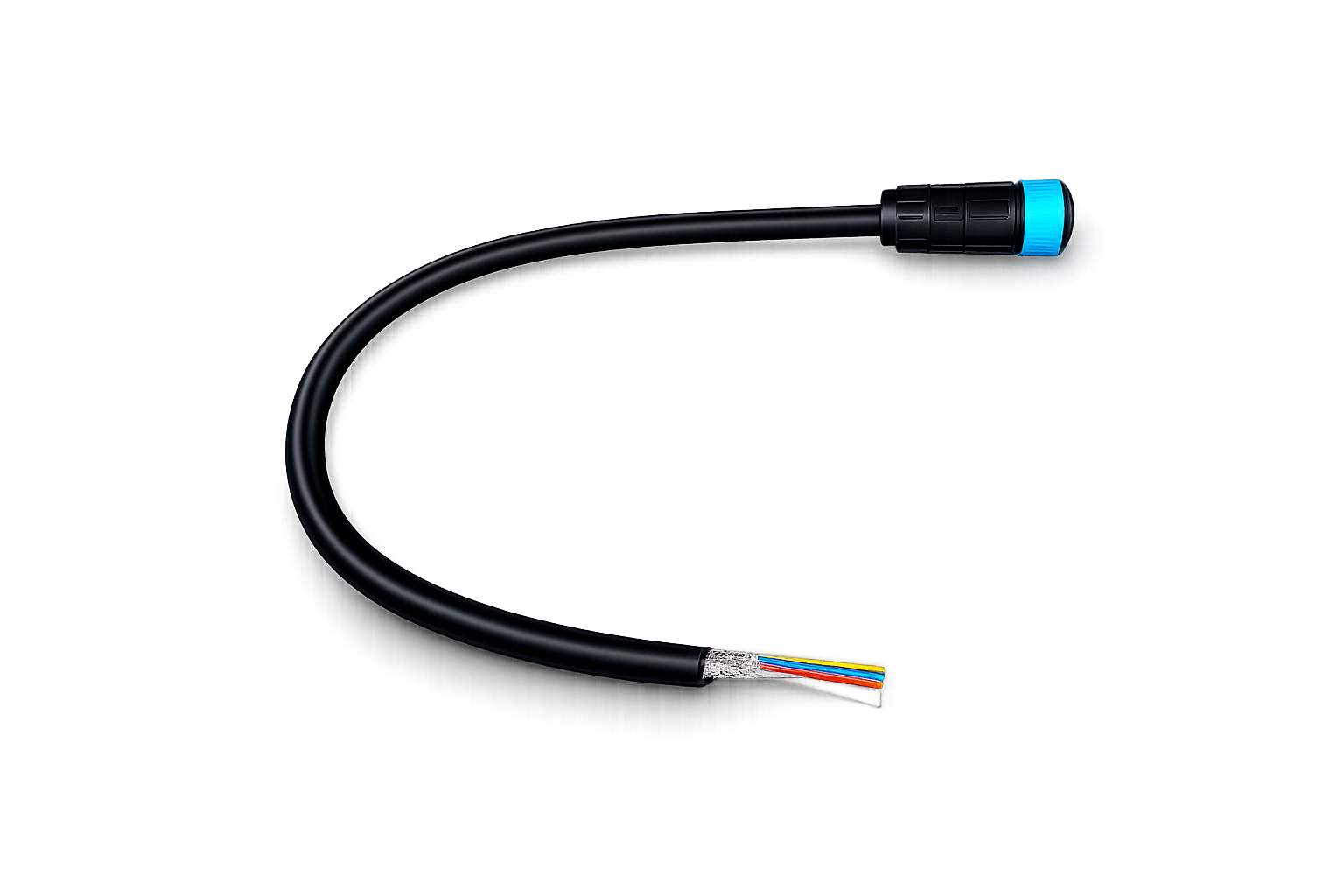
An installation that looks clean from the front may expose cable loops and connectors when viewed from the pavement. Photograph the complete installed assembly from below, not only the glowing cover. Show where input and output cables run, where joints sit and how spare cable is retained without obstructing the fixture or putting strain on connections.
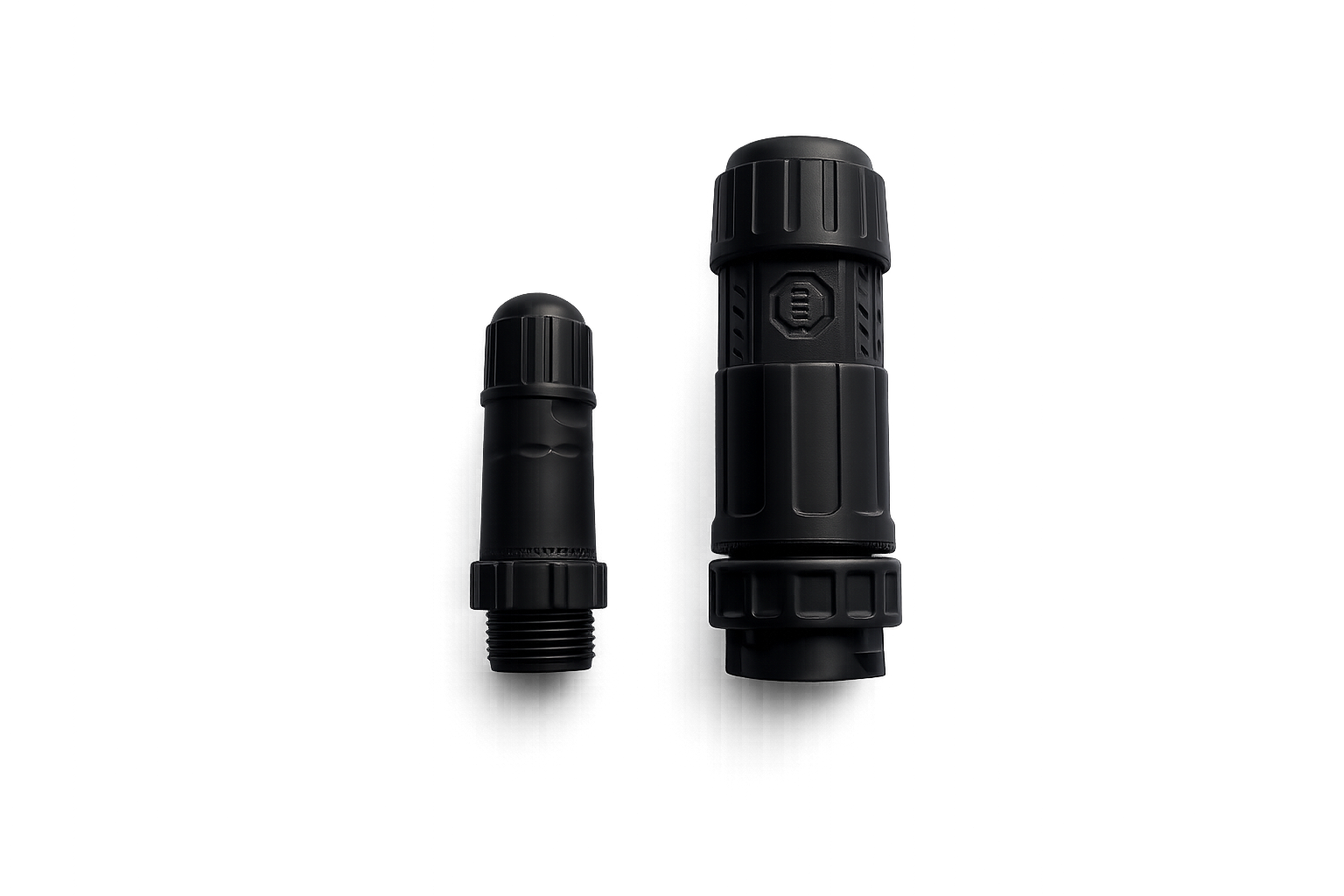
D50 standard versions use LLT connectors: five pins for the 24V configuration and six for the AC configuration. Alternative connector brands can be supplied to match a project interface, subject to the specified electrical and mechanical arrangement. Matching pin count or external shape alone does not establish compatibility — and a connector adaptation does not convert a 48V system into a compatible D50 power source.
Pin count is not compatibility
Compare the connector envelope and the cable manufacturer’s bending requirements, not only lamp-to-lamp spacing. The referenced Traxon specification gives connector clearance and cable-bending details explicitly; D50 routing should be shown against its own approved installation drawing rather than copying those values.
D50’s published minimum fixture spacing is 5 mm. That number is not the complete allowance for all connector arrangements, thermal conditions or maintenance operations. Include actual cable bends, bracket access and end termination in the installation detail.
Can one middle fixture be removed?
A practical maintenance demonstration is to install three fixtures and remove the middle one. Record which fasteners and connectors must be accessed, whether neighbouring fixtures move, and how the replacement is reconnected and addressed.
Publish the real sequence instead of promising tool-free or independent replacement without evidence.
Low-voltage and mains-voltage layouts
The 24V DC version takes AC distribution into an external 24V power supply and then into designed DC branches. Control is provided through the appropriate DMX wiring arrangement. Select cable size, feed locations and connected load from the actual design; existing 24V infrastructure can be assessed for reuse, existing 48V infrastructure is not directly suitable.
The 100–277V AC version runs AC distribution and protection into designed mains branches and then into the fixtures. It avoids the same external 24V supply architecture, but still requires appropriate distribution, protection, grounding and connectors. A mains version is not a universal preference: choose it according to the installation environment and project requirements.
Choosing between the two D50 versions Same fixture, different distribution
Either way, use the approved configuration and wiring schedule. These are concept descriptions for selection, not construction wiring instructions.
Power capacity and control capacity are separate limits. For the D50-L12 RGBW, 40 channels per fixture means 12 fully independently addressed fixtures occupy 480 channels in one 512-channel universe. That calculation is not a permitted power-chain length and it is not a universal physical DMX-line limit; the controlling design must satisfy both the electrical and the signal requirements.
Art-Net gateways may carry control over a network and generate DMX near the fixtures. They do not extend the fixture power circuit. Network segments, fibre links and local DMX wiring must each be designed for the selected equipment; a gateway is not permission to use an unlimited copper Ethernet run.
Lengths, pixels and geometric layout
Short lengths can help resolve ends and architectural modules. Use approved drawings for final dimensions and do not assume every length has the same pixel count or channel layout.
D50 published lengths Five models, one body architecture
Select white, RGB or RGBW, and the voltage and control version, explicitly when ordering. Approved drawings govern final dimensions.
For a row of N L12 fixtures, the lamp bodies and the 5 mm minimum inter-fixture gaps alone occupy N × 1222 + (N − 1) × 5 mm, before end clearances and cable requirements. Two L12 units therefore occupy at least 2449 mm on that basis, not 2400 mm. Equal total pixel count would not make two layouts geometrically interchangeable.
For the referenced 2025 products, two 1200 mm Traxon units have 24 pixels, whereas two D50-L12 units have 20. Remap the content to the actual arrangement. Do not infer precise emitter-centre pitch merely by dividing housing length by pixel count; request the physical pixel layout when alignment matters.
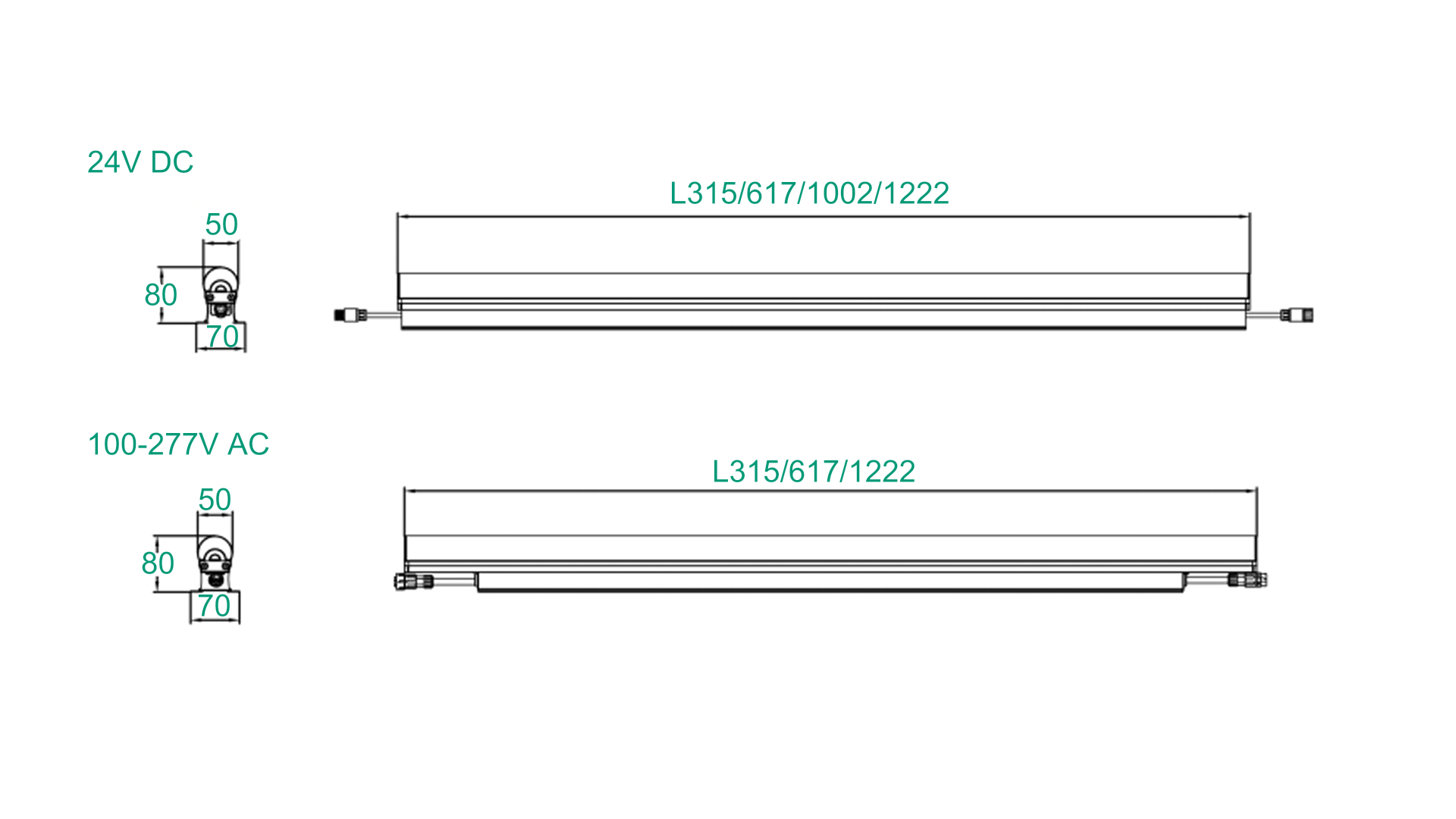
Published lengths and the two input versions
The drawing above shows the D50 body at the published lengths with the 24V DC and 100–277V AC versions drawn separately.
Photo and drawing slot L01 — a to-scale comparison of fixture lengths, 5 mm gaps and pixel centres against the Traxon drawing, taken from both parties’ approved CAD (pending).
View current D50 configurationsEnclosure construction, materials and documentation
D50 uses a double-layer curved PC cover and an inner glass structure. TPK describes separate waterproof barriers: an ultrasonically welded PC cover and a bonded glass structure, completed by the aluminium body and end caps. Explain that construction with an annotated section and the applicable test documentation. Two barriers do not create a new rating above IP66, and they do not establish suitability for pressure washing or underwater operation.
The PC cover combines diffusion with an anti-UV outer layer. TPK identifies BWF as the cover-material supplier and offers material information. The three-year UV statement should be read with its applicable terms.
Distinguish supplier material-weathering data from complete-fixture testing, and identify the actual sample and exposure method whenever a report is shown.
The current product page gives a 30,000-hour fixture lifetime and a three-year warranty. Do not replace those with an LED-package life figure, and do not invent the engineering rationale behind a rating. Likewise, coastal humidity suitability must not be represented as the same documented salt-spray qualification listed for the referenced Traxon version without equivalent evidence.
Certification and technical submittals
TPK confirms separate certification documentation for the standard low-voltage and mains-voltage D50 ranges, covering standard sizes. Custom versions are reviewed separately.
Submit for the exact order code
Attach the certificate and the applicable model schedule for the voltage and configuration actually ordered. Do not rely on a logo or an isolated cover page.
What a project package should identify
The complete order code; dimensions and mounting detail; input and wiring; control-channel schedule; applicable safety and compliance documentation; the relevant IP report and photometric files.
Compare like with like
The referenced 2025 Traxon specification lists CE, UKCA, cETLus, FCC and ANSI C136.31-3G. The purpose here is to match the project’s requirements, not to imply that D50 has more approvals because another brochure omitted a logo.
D50 in completed architectural lighting projects
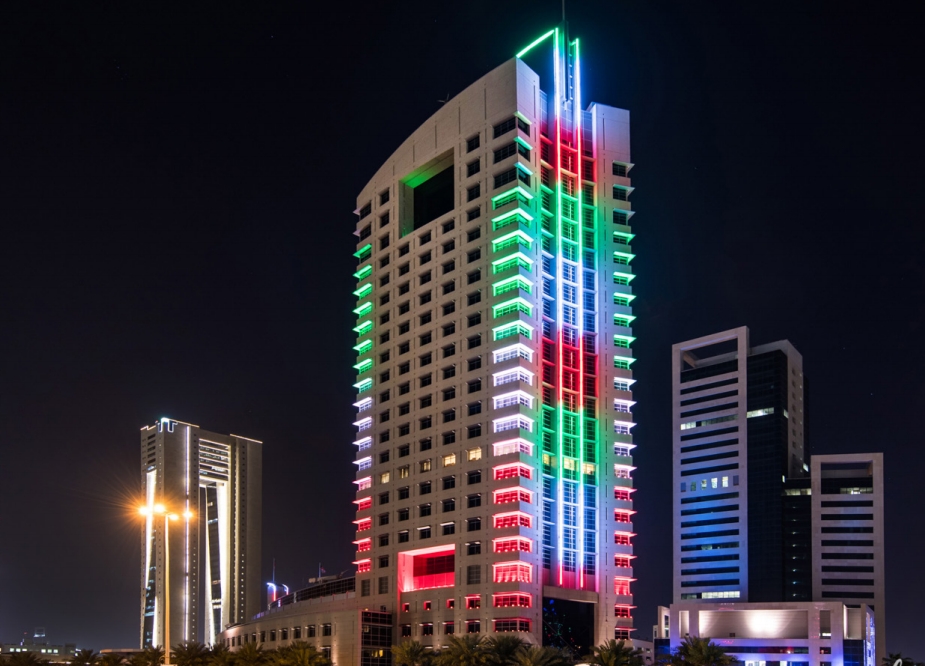
These are application references, not Traxon substitution evidence. Both projects used D50 alongside wall washers under one DMX512 system, which is how the fixture is normally specified.
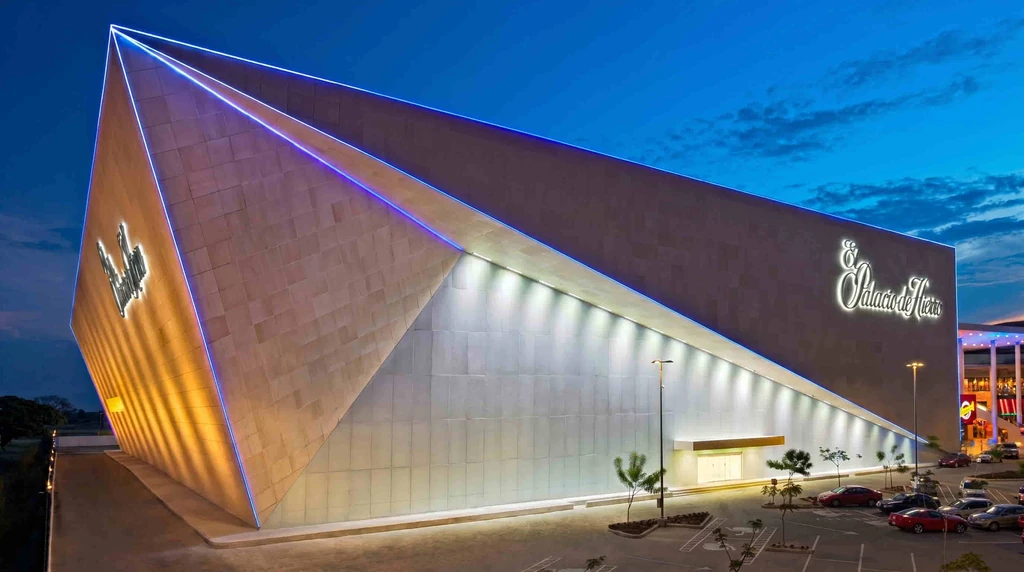
El Palacio de Hierro Villahermosa
At this retail facade, D50 linear lights define the principal angular edges. Wall washers illuminate the faceted planes, while floodlights address the elevated signage. The project page describes a unified DMX512 system coordinating these complementary fixture types.
The example shows D50’s role in architectural edge definition within a wider lighting scheme. It is not presented as a Traxon replacement or a controlled Media Tube Go comparison.
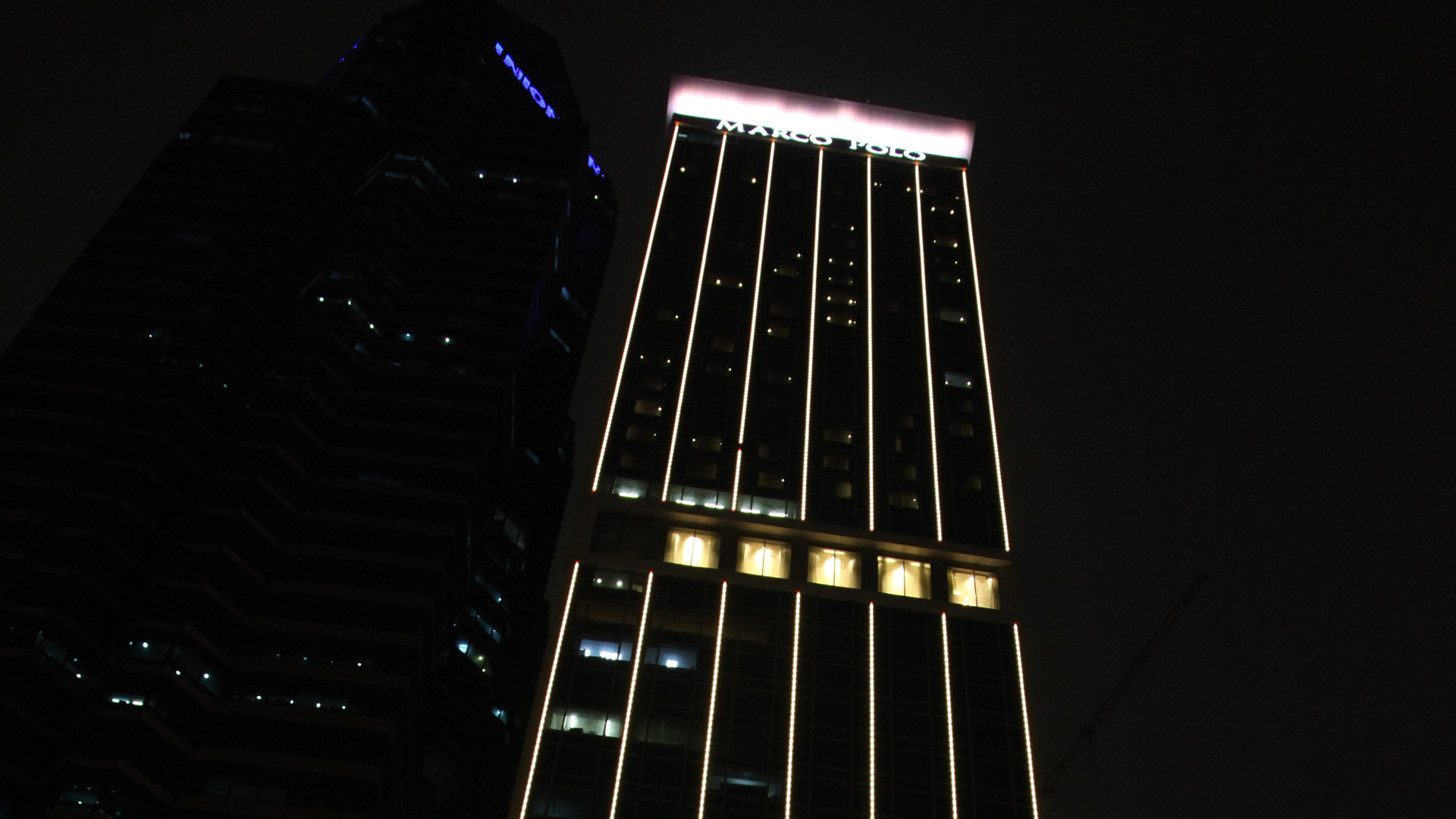
Marco Polo Ortigas Manila
The published project record identifies D50 for vertical facade highlighting alongside LWW-ROWS-W150 wall washers, with DMX512 control. The project is dated November 2014. It provides a hotel-facade application reference rather than proof that every current D50 option was supplied in that historical installation.
The vertical composition is useful when discussing how linear accents complement broader facade illumination. Refer to the original project record for the documented scope, and do not infer present-day maintenance condition from the installation date.
Existing-installation replacement checklist
Before approving a replacement, record the following. Nine items, in this order, will settle most of the open questions in one site visit.
Original configuration
Product code, document revision, optic and pixel configuration.
Supply arrangement
Actual supply voltage and power-distribution arrangement.
Mechanical interface
Housing, brackets, fixing centres, recess space and cable exits.
Connectors
Pin assignments, cable condition and protection requirements.
Control
DMX channel allocation, addressing workflow and scene mapping.
Geometry
Actual run length, fixture gaps and architectural module alignment.
Sample appearance
Sample appearance alongside any retained fixtures.
Service access
Access for middle-fixture replacement and servicing.
Evidence
Required documents, sample approval and site test results.
A representative mock-up should cover front, underside and side views; steady light and contrasting pixels; cable concealment; and one removal and reinstallation sequence. Record any required modifications before procurement.
Frequently asked questions
Is D50 a drop-in replacement for Media Tube Go?
No blanket drop-in claim is made. The referenced 2025 RGBW version uses 48V and 12 pixels per 1200 mm; the D50-L12 uses a different voltage architecture and 10 pixels. Installation and programming must be evaluated accordingly.
Can the existing 48V supply be kept?
Not as a direct supply for the current D50: its available inputs are 24V DC or 100–277V AC, depending on the ordered version. An existing 24V system from a different generation still requires a load and wiring review.
Will both fixtures produce identical pixel effects?
Not automatically. Pixel counts, physical positions, addressing and colour behaviour differ. Reprogram and review the actual arrangement with sample content.
Can connector customisation retain existing cabling?
It can address a specified connector interface, but not an incompatible voltage, unsafe cable condition or incorrect pin assignment. Retention requires a documented electrical and mechanical match.
Do I need actual Traxon samples to use this guide?
Official drawings and specifications can support a labelled document comparison. D50 photographs demonstrate D50 only. Claims of measured optical superiority or equivalent installed appearance require an appropriately controlled comparison.
Which project evidence should I review?
The linked Villahermosa and Manila case studies show D50’s documented architectural role. The product documents and a project mock-up are what evaluate the current selected configuration.
Request a project-specific D50 comparison
Send the complete Media Tube Go reference, its datasheet revision, fixture quantities, installation drawings, supply voltage and control requirements. TPK can prepare a configuration comparison, identify the necessary changes and assemble the relevant technical documents for review.
Traxon, Media Tube and e:cue are trademarks of their respective owners. TPK Lighting is an independent manufacturer. This guide does not imply affiliation with or endorsement by Traxon or e:cue. Contact: ES2@topkinglite.com