


Color Kinetics Accent MX Alternative:
Evaluating TPK Lightning LLS-OP-W100
A project-focused guide to 100mm-wide architectural contours, three-sided direct-view optics, joints, mounting and control architecture. Both luminaires belong in the direct-view selection discussion, but they are not interchangeable drop-ins — this guide walks through where each one fits.
Three-sided light emission
17 W and 34 W versions
Not offered as an Accent MX substitute
1 · Start with the contour, not the wattage
A direct-view outline is part of the visible composition. Its apparent width, uniformity, joints and appearance from below may matter more than a maximum lumen figure. W100 is intended to be seen as a luminous contour along building frames, rooflines, bridge elements and architectural edges; Accent MX Powercore gen3 is likewise described by its manufacturer as an exterior linear direct-view luminaire for long ribbons of colour.
Configuration comparison Accent MX Powercore gen3 reference vs W100 selection
The profile comparison uses the published Accent specification, not a measured luminous-aperture test. A body dimension does not prove the entire width is emitting — final drawings should identify the emitting surfaces and bracket-inclusive dimensions.
2 · Define the exact configurations
Compare a specific Accent MX Powercore gen3 RGB order code with a specified W100 length, colour, voltage and control version. Accent is a family: a limitation stated for Accent MX must not be applied to Accent Compact RGBW or the whole portfolio.
Same nominal width, different depth and aperture
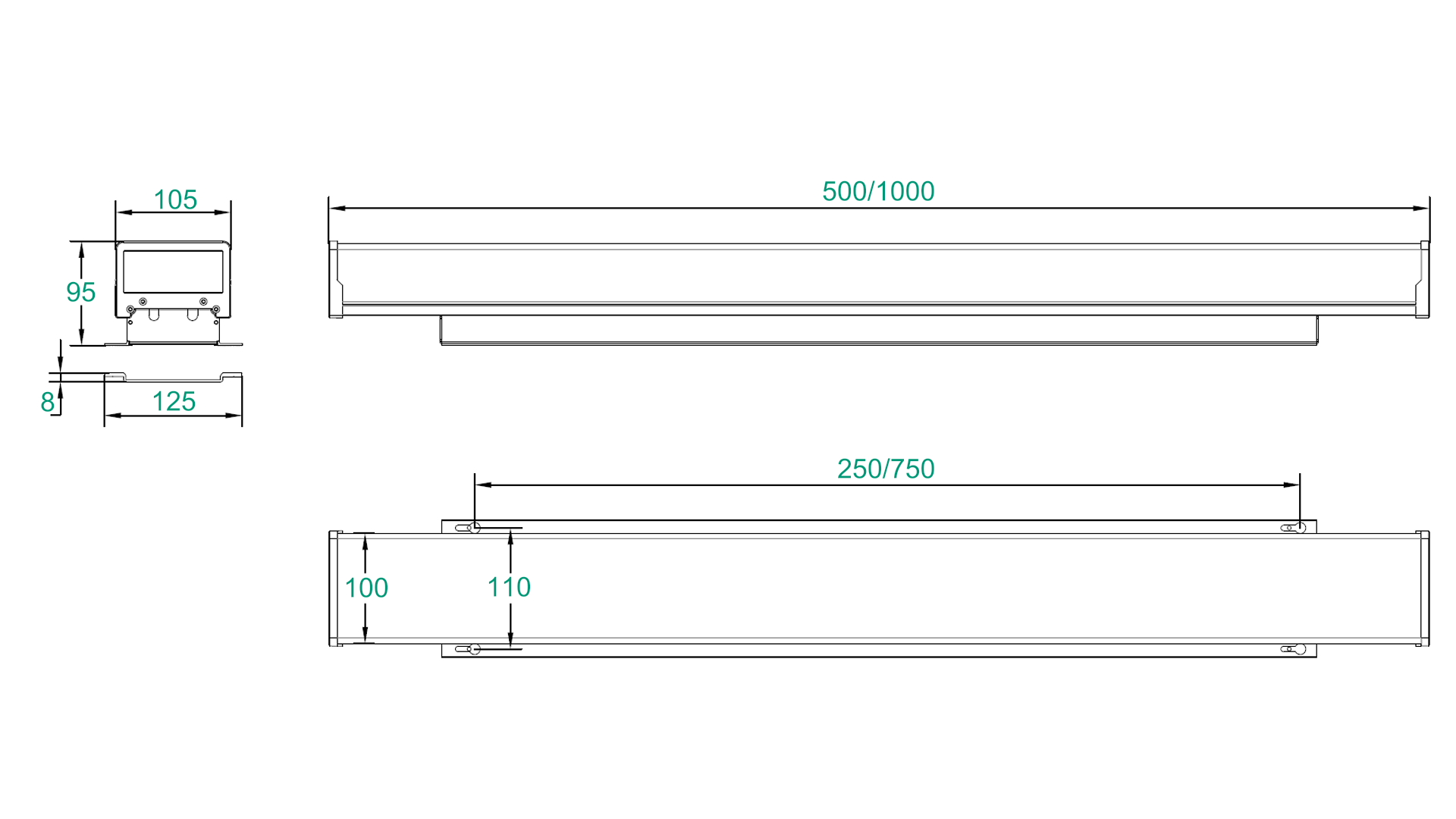
W100’s 100 × 100 mm profile and three-sided emission produce a broader, three-dimensional luminous contour. This is where viewing angle decides the outcome: along high parapets and rooftop cornices, or from a street-level up-view, a two-dimensional front-facing aperture is easily cut off by the structure’s own underside, while a three-sided contour keeps its full 100 mm luminous width reading from below. A wider line is not automatically a brighter or more efficient line — check orientation, luminous aperture and the total installed envelope, not width alone.
Schematic drawn from published body dimensions; not a measured luminous-aperture test.
W100 dimensions & CAD3 · Front, side and underside appearance
W100’s three-sided emission is relevant when viewers approach along a facade, see a roofline from below or look across an architectural corner. A front photograph alone cannot demonstrate this — use the distribution data and an installed mock-up together.
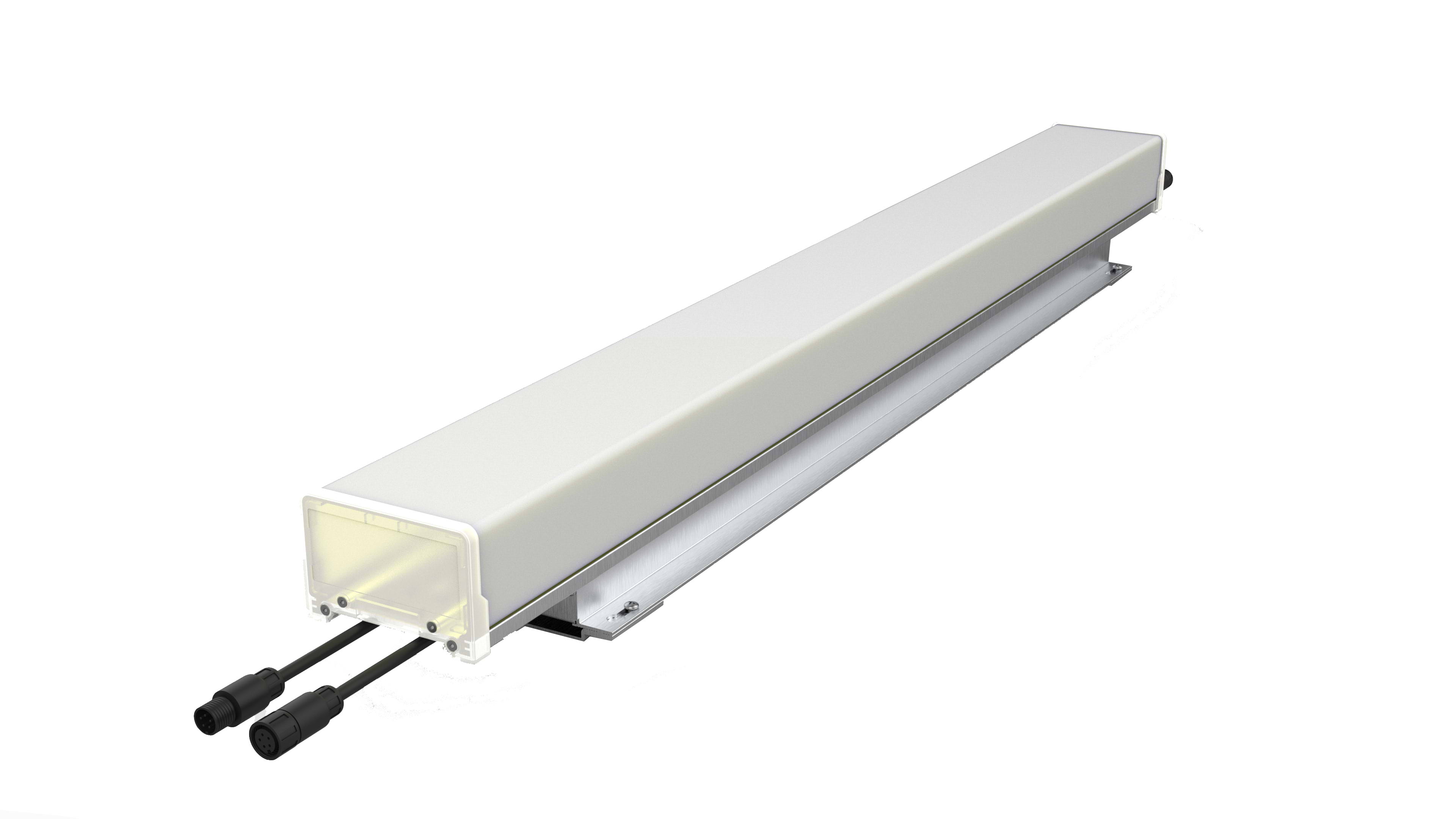
LLS-OP-W100
Diffused PC cover with three-sided emission. The fixture itself forms the visible line — light spilling onto an adjacent wall is secondary and is not a wall-washing performance claim.
Product page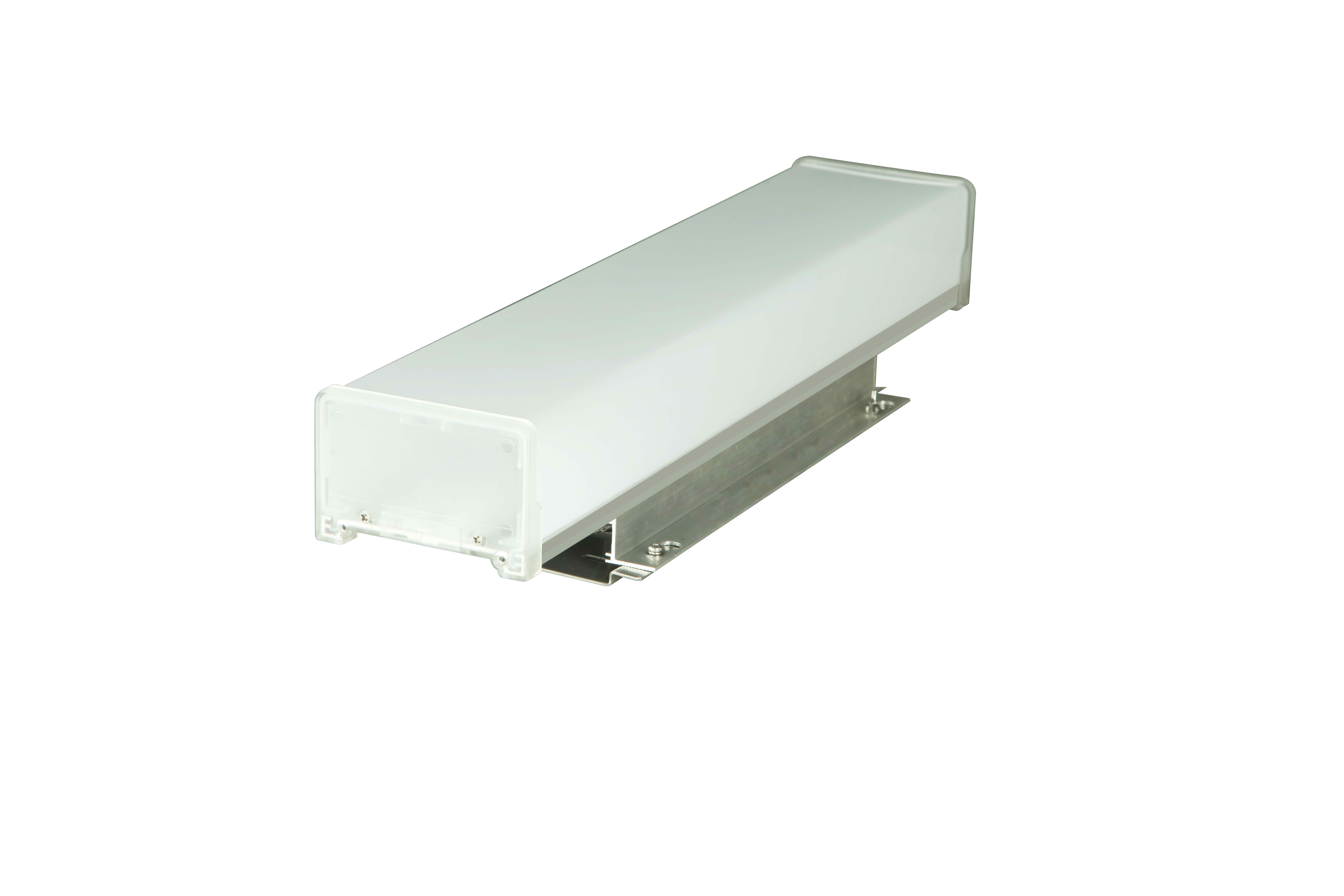
Diffusion and joints
Accent also uses a direct-view diffused lens, so smooth diffusion is not exclusive to W100 — the difference shows at the wider emitting surfaces and at the joints between fixtures. W100’s thin end covers and low-profile alignment brackets keep the physical gap between emitting surfaces small, and lateral light from the three-sided diffuser blends across the joint at normal viewing distances.
Joints, corners and end termination
For a contour, each joint repeats throughout the installation. A broad contour makes corners and ends conspicuous — the terminal face, cable position and the last module must be shown with the real mounting arrangement.
Ask for evidence. A close joint view and a run of at least three connected fixtures show how the line reads in practice. Treat a seamless 90° corner or a luminous end face as unproven until that exact configuration is demonstrated, and keep the clearance the installation instructions require.
Daytime look, wiring and maintenance
The unlit installation is part of the design: housing finish, complete projection from the wall, bracket visibility and visible cables all count. For high-specification commercial projects, W100 is available with a Custom Architectural Finish — Dark Bronze, Champagne or a custom RAL — so the housing reads as part of a dark metal curtain wall by day and disappears into the facade. When a U.S. general contractor’s 2023 submittal required finish swatches matched to facade panels before tender, factory colour-chart verification closed a gap that catalogue finishes could not. W100’s deeper body provides physical presence but also requires space.
Verify by removal. Install a representative short run and demonstrate removal of a middle fixture with power isolated — tools, connector access and whether neighbouring modules must be loosened. Existing Data Enabler output is not a plug-in interface for W100; cable reuse depends on the selected voltage and control configuration.
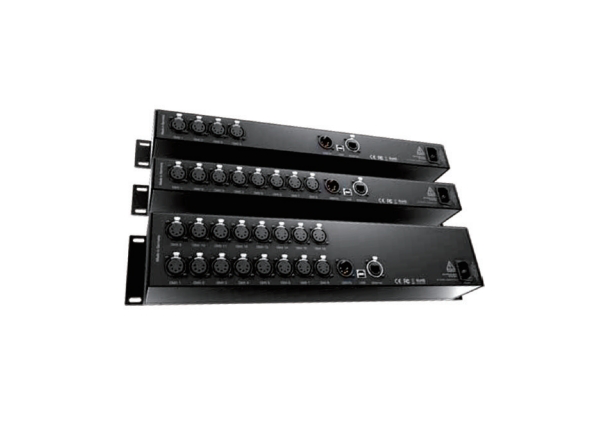
The flip side — new construction. For new construction or full-system retrofits, bypassing proprietary enablers like Data Enabler Pro eliminates single-vendor lock-in, significantly reduces auxiliary hardware procurement costs, and allows seamless native control via standard DMX512/RDM controllers (such as MADRIX or Pharos).
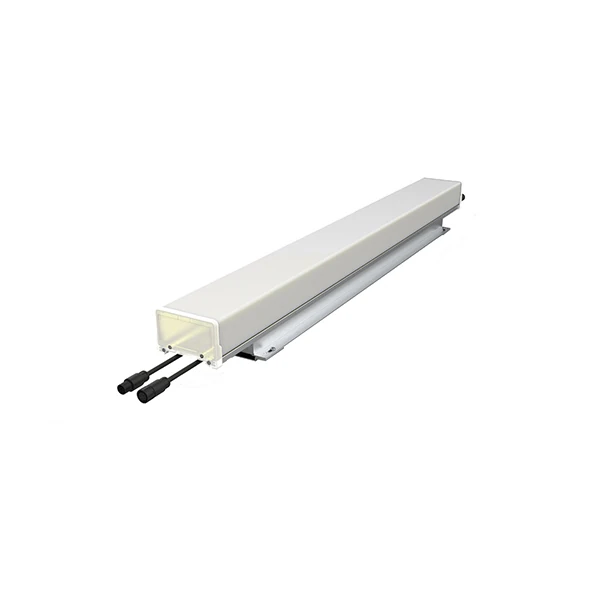
Switching an existing Accent MX run to W100
W100 is a forward selection for new projects and full-system upgrades, not a plug-and-play swap for single failed units inside an existing Accent run. Five points settle most of the feasibility question: power and data — Data Enabler Pro boxes and their hybrid cabling cannot feed W100, so plan standard DC or AC power runs plus shielded twisted-pair DMX. Mounting — the 100 mm body needs bracket, coping and standoff clearance the shallower Accent profile did not. Control — controller universes must be re-patched for module-level addressing instead of 30 mm increments. Colour — scenes built on RGB mixing should be re-targeted to dedicated white or RGBW for maximum output and purity. And finally, a sample mock-up at the real viewing distance settles the daytime and nighttime questions no datasheet can.
4 · Application evidence
References show how wide contours behave on real buildings — what the hardware reads like by day, how the line holds at distance, and what the control infrastructure looks like behind the scenes.
Porter House Roof Top, New York
A 17 kW rooftop outline built from 500 custom Bronze-finished LLS-OP-W100 RGBW units, driven over a 16-universe DMX512 network through MADRIX LUNA Art-Net nodes on a 24 V DC ETL-recognised supply. The bespoke Bronze housings match the building’s metalwork, so the installation reads as architecture by day and a pure luminous contour by night.
Sichuan Luojiang Student Incubation Base
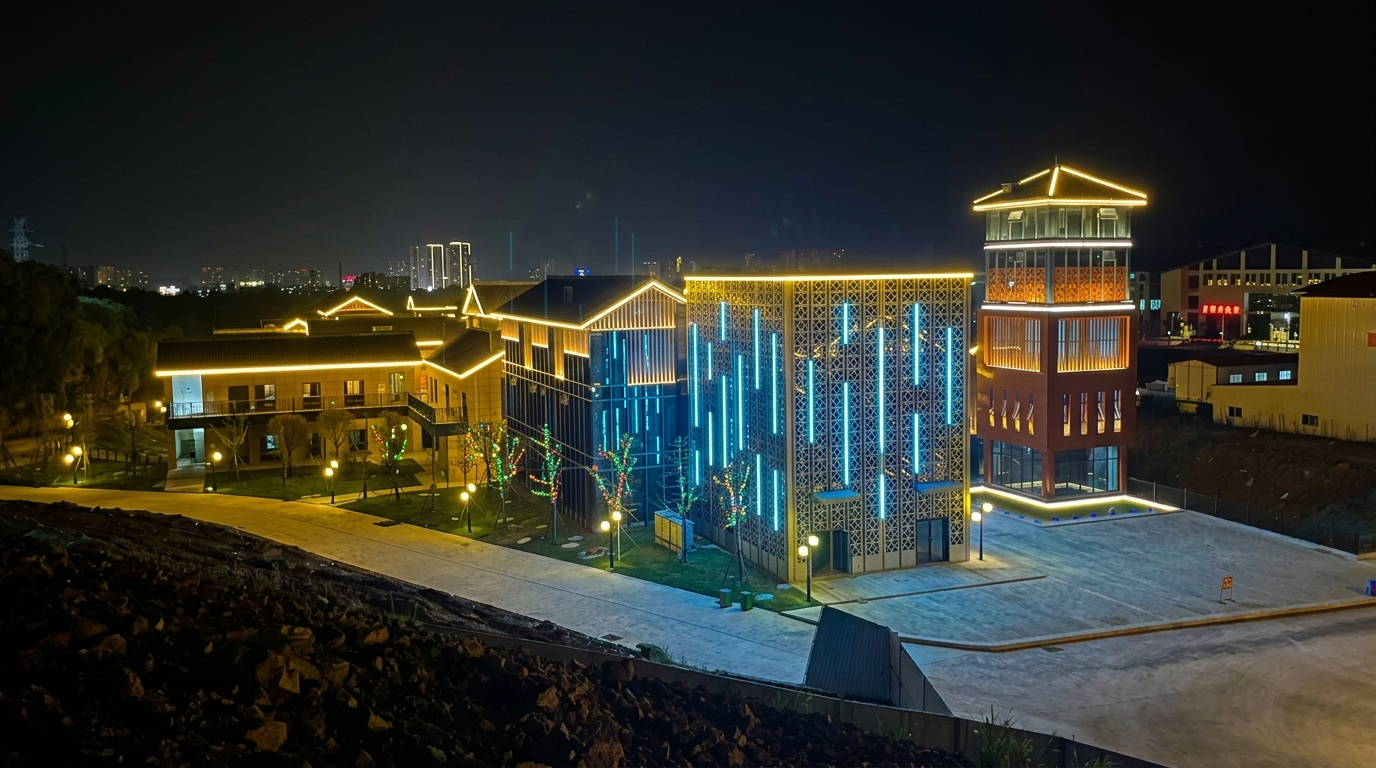
Continuous contour runs trace the campus facades, documented with night photography on the project page. The fixture schedule there lists the W30 platform — a narrower body in a similar role — so the project illustrates the campus-scale look of contour lighting rather than a W100 installation.
5 · Frequently asked questions
Request a project-specific W100 comparison
Send the Accent reference code, outline drawings, desired colour, control requirements and mounting photographs. TPK can prepare a configuration comparison and identify the changes and supporting documents needed before approval.
Color Kinetics, Accent, Powercore and Data Enabler Pro are trademarks of their respective owners. TPK Lighting is an independent manufacturer; this guide is not affiliated with or endorsed by Color Kinetics or Signify. Technical references: Accent MX Powercore gen3 published specifications (colorkinetics.com); LLS-OP-W100 product page and manufacturer confirmation for the CCT/Ra palette, custom finishes and warranty; Porter House Roof Top and Sichuan Luojiang project pages on this site.